


![Alexander Oki ‘28 picks up trash in the lower parking lot Feb. 20. According to Keep America Beautiful, the majority of the trash found on both roads and waterways consists of fast food wrappers and packaging, receipts and plastic beverage bottles. Clubs like the National Honor Society (NHS) offer students the opportunity to earn service hours by cleaning up the trash in the parking lots. “[The trash] makes us look very unhygienic and unmotivated to be a proper school,” Emberlyse Vidal ‘28 said. “It makes us look like we just don't care about our students' environments.”](https://rockmediaonline.org/wp-content/uploads/2026/03/20260220_1355020-2-1200x904.jpg)


As concerns over student use of communication device use in schools have grown within the United States, a greater push for stricter technology policies has sparked. A recent wave of passed bills means a majority of K-12 students nationwide will be banned from using their personal devices in school during the 2025-2026 or 2026-2027 school year.
These laws will vary depending on their respective states, with 31 states already executing a ban or planning to do so. Colorado, alongside Alaska and Minnesota, has not yet implemented a state-wide cellphone ban in schools.
However, House Bill 1135, a law passed this year, requires that all school districts within the state must post on their websites a policy concerning communication device use during school hours by July 1, 2026.
“[We want to make sure] we craft a policy, a very thoughtful policy that makes sense for our entire community, but to also make sure that our families have the resources they need to assess when is the appropriate time for their kids to have a cellphone, how they use it, ways to lock it down etcetera,” Chief of Staff Steve Colella said during the forum.
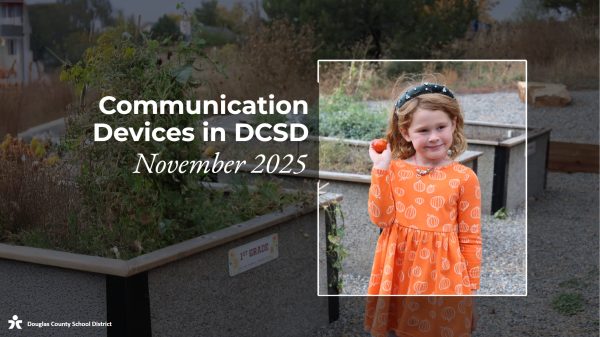
In response to these developments, the Douglas County School District hosted a community forum Nov. 6 to address the creation of a cellphone policy, featuring an informative talk about youth cellphone use by Dr. Kelli Smith and the planned course of implementation by Superintendent Erin Kane, Chief of Staff Steve Colella and Chief Technology Officer Mark Blair. The meeting invited public comments from students, parents and faculty on the matter.
On Nov. 18, the district held another community forum, this time virtually through ZOOM, to provide further updates on the in-progress policies and receive feedback from participants. It lasted from 6 p.m. to 7:25 p.m. with 328 members.
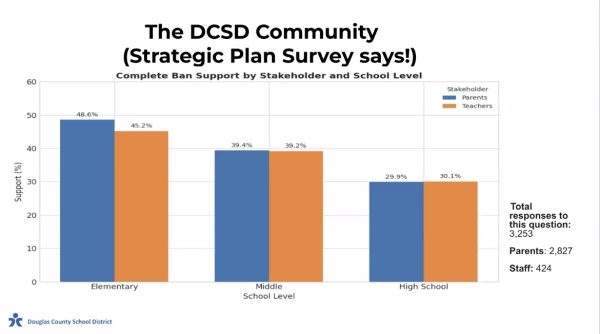
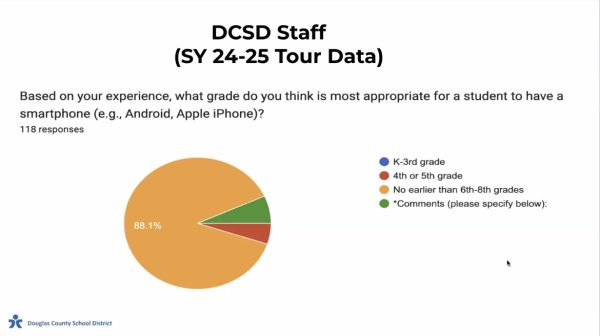
Once again, the meeting was led by Kane, Colella, Blair and Smith. It opened with a summary of the DCSD Strategic Plan concerning communication devices, including its purpose, end statement and foundational commitment. Colella also reviewed the results of the Strategic Plan survey, which received approximately 3400 responses, and a tour conducted with DCSD staff throughout the 2024-2025 school year.
“We started this conversation really [at] the beginning of last year,” Colella said. “As Superintendent Kane alluded to this part of our Strategic Plan process, she asked a question on the Strategic Plan survey along with AI and a variety of other topics. [Mr. Blair and I] went to various high schools and middle schools last year, brought pizza for lunch, talked to staff, it was awesome. We talked with leaders on a once a month basis to talk about their experiences with AI along with their experiences with cellphones and what they were working through.”
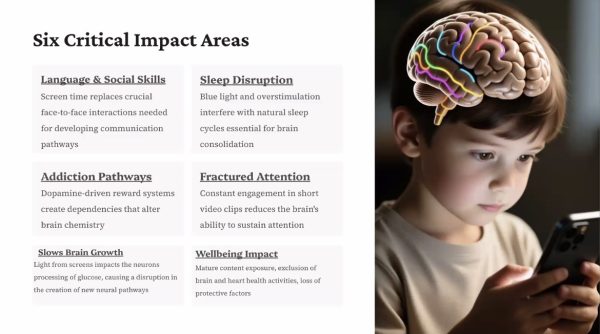
Smith, a 17 year-long educator and 32 year-long principle, presented a second time the scientific effects communication device use has on the brain development and mental health of children, focusing mainly on its influence on social behaviors and connections. She aimed to spread awareness on the possible harms of excessive screen time to parents.
“It’s important that when we think about screens, it’s not all good, it’s not all bad,” Smith said. “It’s what they are doing and their engagement with the environment and the world that’s creating these neural pathways. We know that when kids interact, however they interact, that’s what shapes their brain. So [when] kids are on screens throughout childhood and not interacting socially, they’re not developing relationships with kids their age, they’re not having conflict and learning how to get out of that conflict, they’re not developing these critical skills that they need when they get into school. ”
The meeting concluded with an approximately 40 minute Q&A session. Participants entered their questions about district plans and cellphone policies via the chat function of the app and were answered by both Colella and Smith.
Staff, student and family input will be completed Dec. 2. Policy Review by the Board of Education will take place December 2025 to January 2026—though this is a tentative time frame due to the board having four new members—and implementation will occur February to August 2026.
“We’ve had family conversations, we’re busy gathering family input and we’ve had a lot of staff, a lot of students, a lot of leader input, a lot of community input as well,” Colella said. “We want to make sure that the board has the easy ability to access all of the data at a time that makes sense for the board. Certainly, that [information] will be publicized once that’s set in stone, and that should be set in stone relatively soon.”
The Strategic Plan survey is still open and available to fill out on the DCSD website. The slideshow presented at the Nov. 6 and Nov. 18 forums is posted on the Digital Literacy page. Community members are free to email Colella at [email protected] with any unanswered questions.