


![Alexander Oki ‘28 picks up trash in the lower parking lot Feb. 20. According to Keep America Beautiful, the majority of the trash found on both roads and waterways consists of fast food wrappers and packaging, receipts and plastic beverage bottles. Clubs like the National Honor Society (NHS) offer students the opportunity to earn service hours by cleaning up the trash in the parking lots. “[The trash] makes us look very unhygienic and unmotivated to be a proper school,” Emberlyse Vidal ‘28 said. “It makes us look like we just don't care about our students' environments.”](https://rockmediaonline.org/wp-content/uploads/2026/03/20260220_1355020-2-1200x904.jpg)


LAST UPDATED NOV. 13
Regulations on communication devices have appeared nationwide—primarily as “cell phone bans” as governments across the country attempt to regulate student use of screens in school. According to Ballotpedia, 26 states across the country have laws or executive orders banning or limiting cell phone usage in schools K-12—22 of which have been enacted in 2025.
Colorado, Alaska and Minnesota are the only states that have enacted legislation that do not limit cell phone usage on a statewide basis.
“As a system, we [have to enter into a] big conversation with our families. We don’t want to just come in from above and [implement a] bell-to-bell ban for everybody,” Superintendent Erin Kane said during the forum. “There’s so much to balance. And we really want to hear from our families.”
Colorado’s passing of HB25-1135—a bill that requires all school districts to create and institute communication device use policies by July 1, 2026—has prompted the beginning stages of Douglas County School District’s creation of said policy.
As defined by the bill, communication devices are classified as “..device[s] that [are] capable of making and receiving calls, sending and receiving text messages, or accessing the internet.”
The bill specifies that this definition primarily applies to cell phones and watches, and excludes laptops or tablets used for school purposes.
On Nov. 6, the district held a meeting at the DCSD headquarters that invited community members to provide feedback as they begin creating their policies ahead of the July 1 deadline.
The meeting featured both an informative talk about the concerns of phones on child development from Dr. Kelli Smith and a sample course of action the district plans to implement from Superintendent Erin Kane, Chief of Staff Steve Colella and Chief Technology Officer Mark Blair.
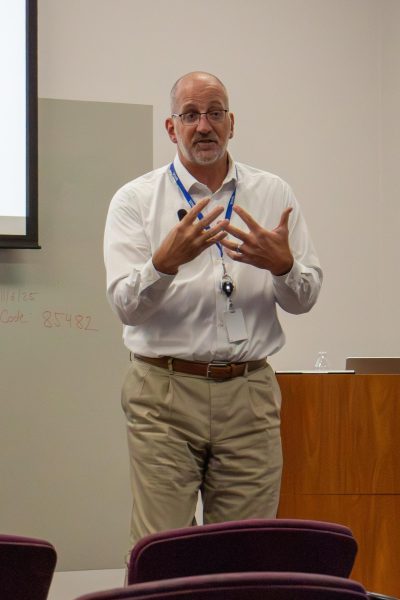
“Humans are meant for connection and attunement,” Smith said. “That’s how kids learn conflict resolution, that’s how they learn coping skills, that’s how they learn empathy. And when they’re replacing those kinds of learning experiences with screens and cell phones, they’re not getting that.”
“Building relationships [and] the neural pathways that form deep, meaningful connections require conflict resolution. So, the thing that I always try to get across is that all screen time is not bad. It’s what they’re doing on screen and the cost of what they could be doing off screen.”
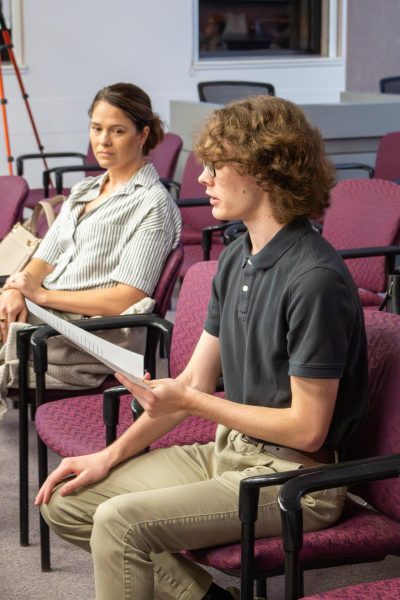
The meeting ended with public comment from students, teachers and parents as board members received and responded to feedback. Rockmedia’s multimedia editor Evan Jensen ‘26 spoke in regards to potential impacts of a ban on student media programs.
“I ask that the board understands that what we do as a program sets students up for success in the real world, and that taking away the resources that we have now will set us back years,” Jensen said. “Students are receiving career experience inside of this class, in which phone use is aligned to professional media standards.”
Rockmedia also spoke with Board Director Susan Meek about her personal opinions as the board begins to approach the policy.
“It’s kind of hard to speak to what the biggest struggle is without knowing what that plan is,” Meek said. “But typically, anytime you’re implementing anything in a district, it’s ensuring education[,] awareness and consistency.”
The district plans to hold another forum virtually Nov. 18, open to community members as they continue to build their policy. For more information, visit the DCSD website’s Digital Literacy page for more resources about digital citizenship and the district’s planned course of action.
Saanvi • Mar 28, 2026 at 7:22 pm
I really liked how this article highlighted both the benefits and challenges of limiting phone use in schools. Including perspectives from experts, students, and district leaders made the issue feel well-rounded and showed how complex the decision really is.